The Cold Kitchen Advantage: Learning Rough Puff Before the Christmas Rush
There is a particular sort of November morning in Essex when the kitchen window has misted on the inside, the radiator is still deciding whether to bother, and your hands are cold enough to make pastry properly. Most people see that as a reason to turn the oven on and stay near it. I see it as the ideal conditions for rough puff.
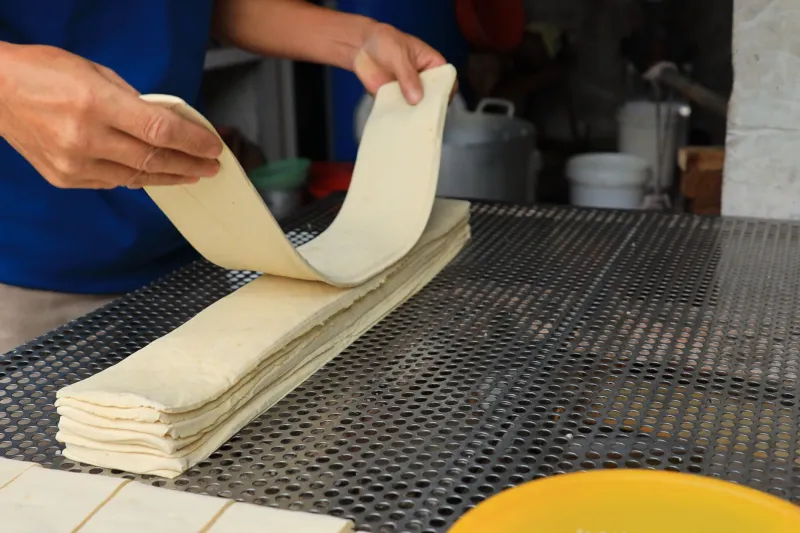
Laminated pastry — the family that includes rough puff, full puff and croissant dough — is really a story about layers. You put butter between sheets of dough, roll it out, fold it up, and repeat. The butter stays in distinct bands. When it hits a hot oven, the water in the butter turns to steam and pushes the layers apart. If the butter melts before it gets there, you lose the lift. If it is too hard, it cracks and tears. Rough puff is the forgiving middle ground: not the mirror-smooth showpiece, but the flaky, buttery, deeply useful pastry that belongs in a home kitchen.
Why cold weather is on your side
Lamination is a battle against warmth. A hot kitchen makes butter greasy and dough sticky. A cold kitchen keeps everything where it should be. The low humidity of a crisp November day also helps: flour drinks less moisture from the air, so your dough behaves more predictably. You are not fighting the room.
This is why the weeks before Christmas are such a good window. You have a legitimate reason to make pastry — sausage rolls, cheese straws, a mushroom pithivier for a Sunday lunch — and the weather is doing half the work. Think of it as a short, free course in handling. By the time December arrives with its mince pies and its visitors, you will have made the mistakes already.
The basic rhythm
Rough puff does not need ceremony. A reliable starting point is equal weights of plain flour and cold butter — say 250g of each — with a good pinch of salt and enough iced water to bring it together, usually around 100–120ml. Cut the butter into rough cubes, no smaller than a sugar lump. Toss it through the flour, then add the water gradually until you have a shaggy dough. You are not looking for smooth. You are looking for a dough that just holds.
Wrap it and chill it for at least twenty minutes. Then begin the folds. Roll into a long rectangle, fold the top third down and the bottom third up, like a business letter. Give it a quarter turn, roll again, fold again. Two folds is a good place to start; four gives you more layers and a crisper bite. Rest between folds if the dough starts to feel warm or resistant. There is no prize for rushing.
The three faults everyone meets
Leaky butter. If butter streaks out at the edges when you roll, the butter was too warm or you pressed too hard. Chill the dough, dust with flour, and roll more gently. Next time, start with colder butter and work faster between rests.
Shrinking. Pastry that pulls back in the tin has usually been stretched rather than eased into place. Roll it a little larger than you need, then let it relax in the fridge for ten minutes before trimming. Handle it like something that might tear, because it might.
Soggy bottoms. A wet filling and a cold, thick base are the usual culprits. Pre-heat your tray or tin, keep fillings cool and not too juicy, and bake at a proper heat — 200°C fan or thereabouts for many savoury bakes — until the underside is crisp and golden, not merely pale. If in doubt, slide the tin onto a hot baking sheet.
Beyond the mince pie
Rough puff is far too useful to be kept for Christmas alone. A long sausage roll, made with good pork and a little sage, is a lesson in itself. A cheese and onion plait, with a sharp cheddar and a spoon of mustard, makes a lunch that feels like an event. A mushroom and leek pithivier is a generous vegetarian centrepiece. Sweet-wise, an apple galette — thinly sliced Bramley or Cox with a little sugar and cinnamon — is forgiving and quick. Hand pies filled with leftover roast chicken or a spiced fruit mixture are excellent for the freezer.
The point is repetition. Each batch teaches you something about temperature, pressure and timing that a recipe cannot quite explain. That is why, at Essex Cookery School, we teach lamination by hand rather than by video: your fingertips learn when the dough is ready far sooner than your eyes do.
A skill worth having before December
If you have been meaning to learn pastry properly, this is the month. The air is cold, the oven is on, and the stakes are low. Make a batch, fold it badly, chill it, try again. By the time the Christmas list gets serious, you will have a feel for it — and a freezer with something buttery in it, ready to bake.
If you would rather learn with someone checking your folds and handing you a cold cloth, our winter pastry sessions are designed for exactly this weather. Come with cold hands and a willingness to roll. The rest is layers.