The Knobbly Golden Glut: Turning Essex Quinces Into Winter Gold
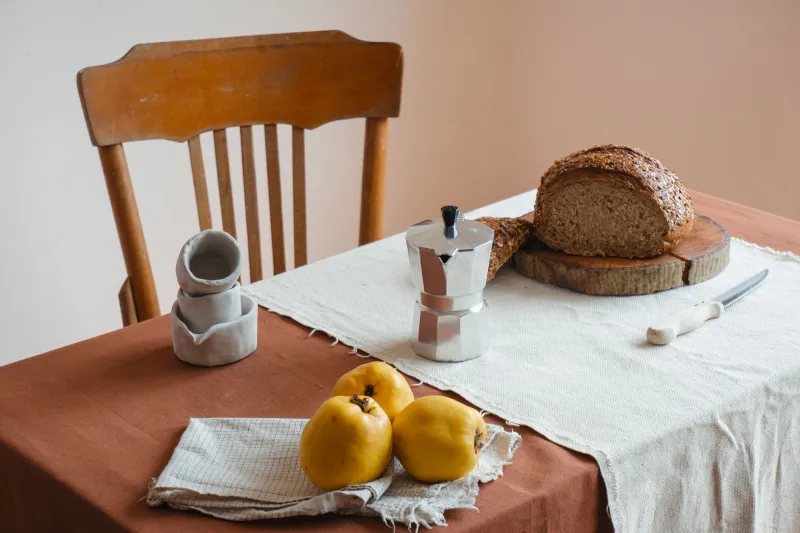
There is a particular kind of Essex garden fruit that arrives with no fanfare at all. It sits in a bowl by the back door, lumpy and pale gold, smelling faintly of honey and roses, looking less like something you would eat and more like something you might sand a table with. That is the quince. And by mid-November, if you are lucky enough to have a tree, a neighbour with a tree, or a market stall with a crate of them, you have what I like to call a golden glut.
Quinces are not a snack. They are a project — a patient, thrifty, deeply satisfying one. They ripen just as the cold settles in, and they seem to understand that November cooking is about making the house smell good and putting something away for later. If you have ever walked past a bowl of them and thought, "Right, but what do I actually do with those?", this is for you.
First, stop squeezing them
A good quince should feel heavy for its size and smell like it means business. The skin is often yellow with a little green still at the shoulders, and that is fine — they will ripen on a cool windowsill. Look for firm fruit with no soft brown bruises, and don't worry about the odd scuff or uneven shape. Knobbly is normal. Perfectly smooth is suspicious.
At home, store them in a single layer in a cool, dark place, not in the fridge if you can help it. They will perfume the whole cupboard. Check them every few days, because one bad quince can persuade its friends to go over. And if someone offers you a bag from their garden, say yes. This is how Essex larders get interesting.
Prep without a battle
Quinces are hard. Properly hard. A sharp knife and a steady board are non-negotiable, and a little common sense goes a long way. Wash off the grey fuzz, then cut around the core in quarters or thick wedges. You do not have to peel them — the skin softens beautifully in long cooking and gives a lovely blush to the syrup. Just trim away any bruised or woody bits.
As you cut, drop the pieces into a bowl of water with a good squeeze of lemon. Quince browns quickly, and while the colour change is harmless, the lemon keeps everything looking cheerful. If a fruit is especially stubborn, cut it into smaller pieces rather than wrestling a whole one. There is no prize for brute force.
The easiest win: oven-poached quince
If you only do one thing with your quinces, poach them. It is the gateway method: low effort, big reward, and the poaching liquid is almost as useful as the fruit.
Heat the oven to 160C conventional / 140C fan. Take about 1kg of prepared quince wedges and put them in a baking dish just big enough to hold them in one layer. Add 150g sugar — caster or granulated, nothing fancy — the juice of a lemon, a bay leaf, and a couple of cloves or a star anise if you have them. Pour over enough water to come about halfway up the fruit. Cover tightly with foil and bake for 1½ to 2 hours, until a knife slides in with no resistance at all.
Let them cool in the syrup. That is important — they carry on softening and taking on colour. Keep them in a lidded tub in the fridge for up to a week. Spoon them over porridge, fold them through yoghurt, tuck them under a crumble, or chop them into a sponge. The syrup is excellent stirred into a glass of fizzy water or brushed over a roast pork joint. Nothing wasted, nothing rushed.
A small pot of quince paste
Quince paste — membrillo, if you are feeling Spanish about it — has a reputation for being fiddly. It is not, really. It just needs a timer and a bit of attention. Make a small batch first; you do not need a cauldron.
Take about 1kg of chopped, prepared quince, put it in a pan with enough water to barely cover, and simmer until completely soft — around 30 to 40 minutes. Blitz it to a smooth purée, then weigh it. For every 500g of purée, add 400g sugar and a squeeze of lemon. Return to a low heat and stir. And stir. For 45 minutes to an hour, until the mixture is thick, glossy and pulls away from the pan in a slow, molten sheet. Be careful: it spits like lava near the end.
Test a little on a cold plate — it should set to a soft, sliceable firmness. Pour into a small lined tin, smooth the top, and leave it somewhere cool overnight. Cut into squares and wrap in greaseproof paper. Serve with a sharp Cheddar, a blue cheese, or a slice of cold roast lamb. It also makes a very good homemade gift, which is November thrift at its finest.
Why a class takes the fear out of it
Quinces have a reputation problem. They look difficult, they feel difficult, and recipes often assume you already know what you are doing. That is exactly where a hands-on class earns its keep. Having someone show you how to steady a hard fruit, how thick the paste should be, and how to tell when poached quince is truly tender is worth more than a dozen videos. At Essex Cookery School, seasonal preserving and practical kitchen skills are taught the way they should be — with real ingredients, real knives, and someone nearby to say, "Yes, that's right, keep going."
You do not need a tree to get started. A crate from a market or a bag from a generous neighbour is plenty. And once you have poached your first batch, you will find yourself scanning November hedgerows and garden walls with fresh interest.
A bowl worth sharing
Quinces are not fashionable, and that is part of their charm. They ask for a little time, a sharp knife and a low oven. In return, they fill the kitchen with that strange, sweet, rosy scent and turn a glut into jars and tubs and little wrapped squares of paste. In a month that can feel grey and hurried, that is a very good trade.
So if a bowl of knobbly golden fruit appears on your doorstep this week, do not sigh. Put the kettle on, find your biggest pan, and give them an afternoon. They will repay you all winter.